Release Notes
Here is an overview of the latest features in Release 6.4 for October 2026.
Two-Step Monthly Closing with Approval Process
With TimePunch 6.4, we’re expanding the existing approval processes for work and project times to include an automated, two-step monthly closing.
Going forward, employees can be automatically notified via email about the upcoming monthly closing. This gives them ample time to review their recorded work and project times and make corrections if necessary.
They can then independently initiate the approval process via the online module or the self-service portal.
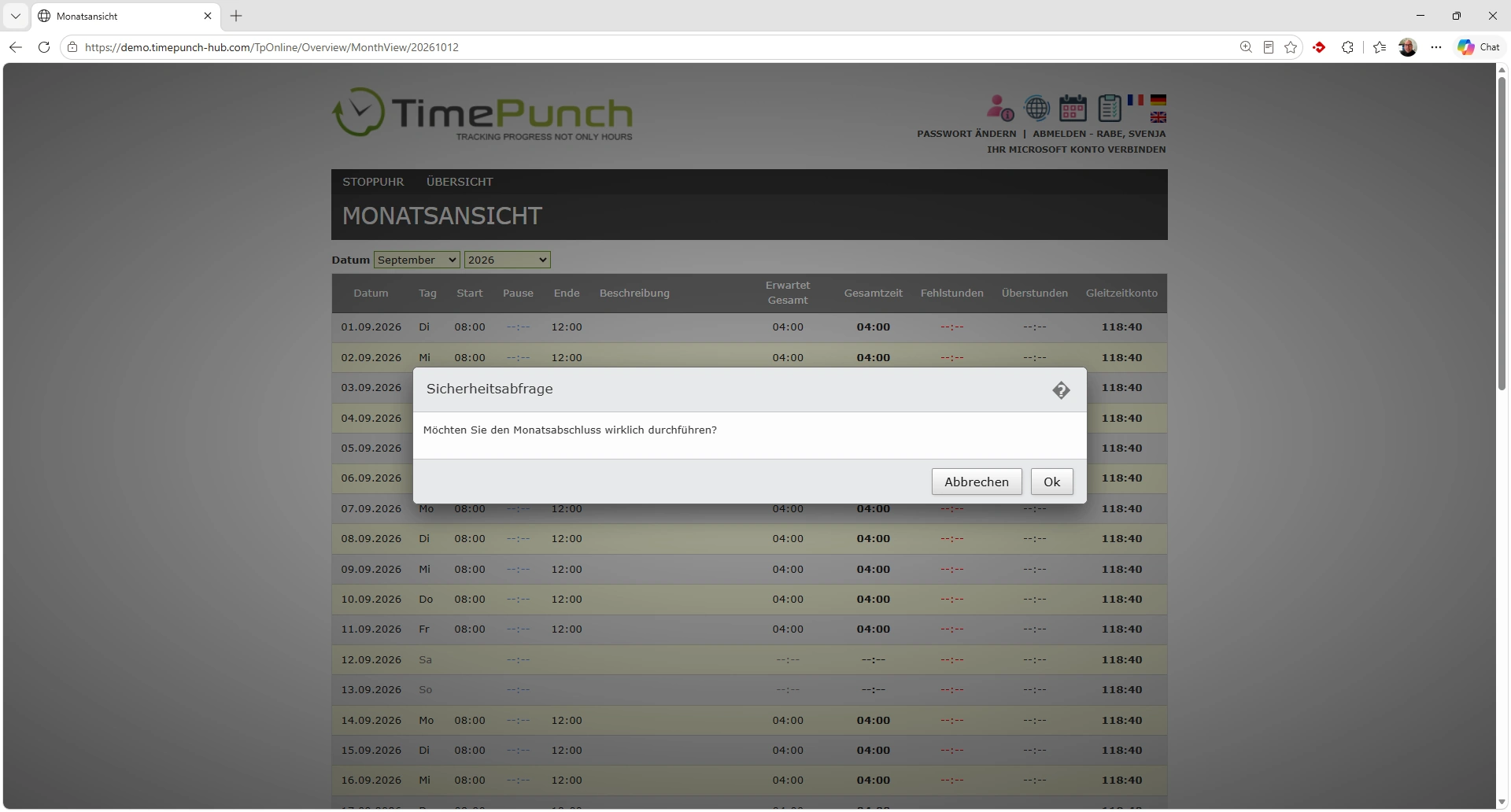
Employees can initiate the monthly closing and the approval process themselves.
During the subsequent approval process, the responsible supervisors and all involved project managers are notified daily via email about any pending approvals. Directly in TimePunch, they can review, approve, or reject their employees’ work and project hours.
As soon as all required approvals have been received, the monthly closing takes place automatically. The closed times are then locked for further editing by employees.
The result: A clearly structured approval process, less manual effort, and a reliable monthly closing.
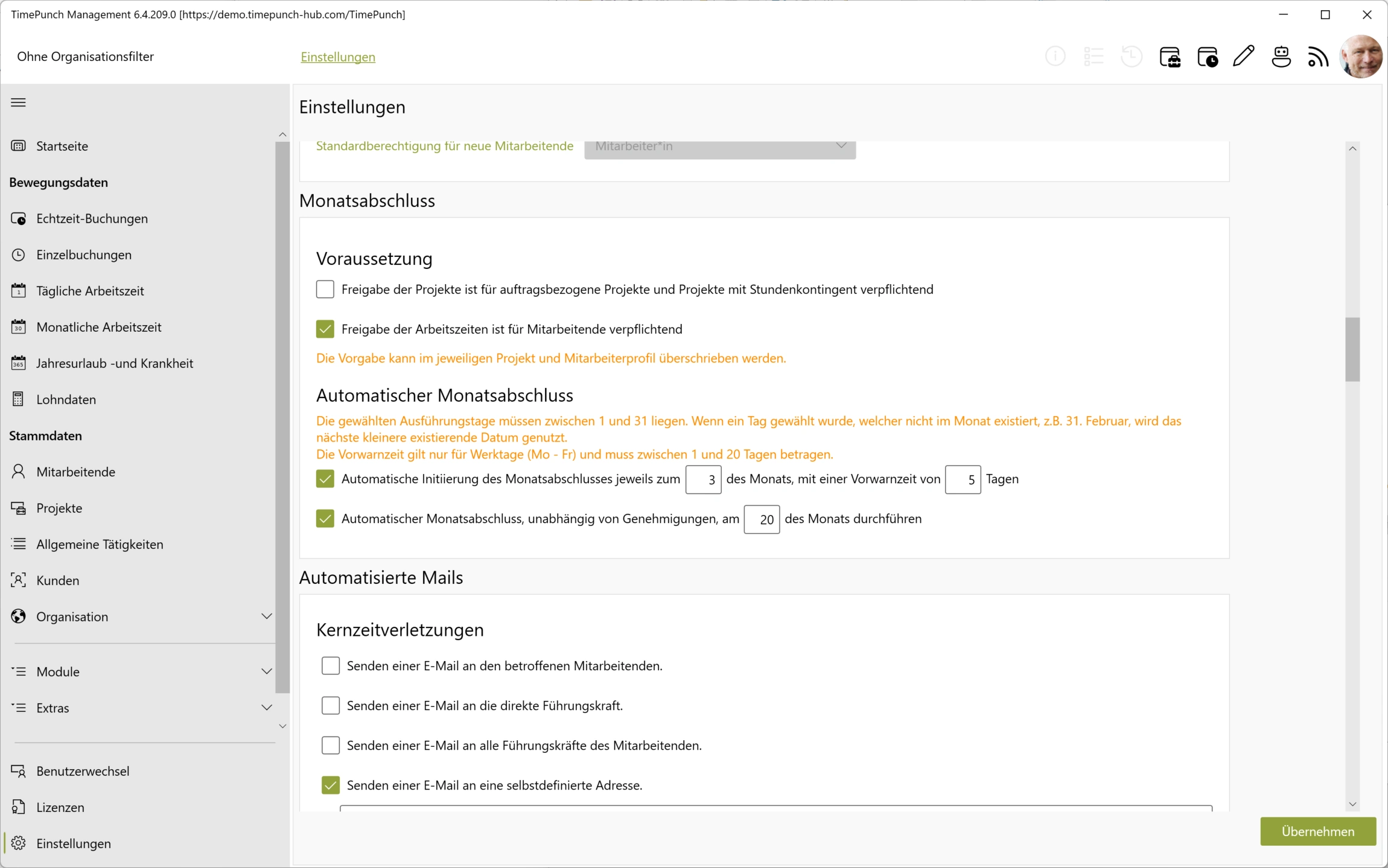
Configuration options for automatic monthly closing and the approval workflow.
Changing Markings Even After Monthly Closing
Another new feature concerns the retroactive marking of work and project times.
Even after a month has been closed, the markers Invoiced, Important, On-Site, and Not Billed can still be adjusted.
This is a significant improvement, particularly for project billing: Employees with at least Project Assistant permissions can set the Invoiced marker retroactively without having to reopen the already closed month.
This way, the monthly closing remains intact while billing-related information can still be updated.
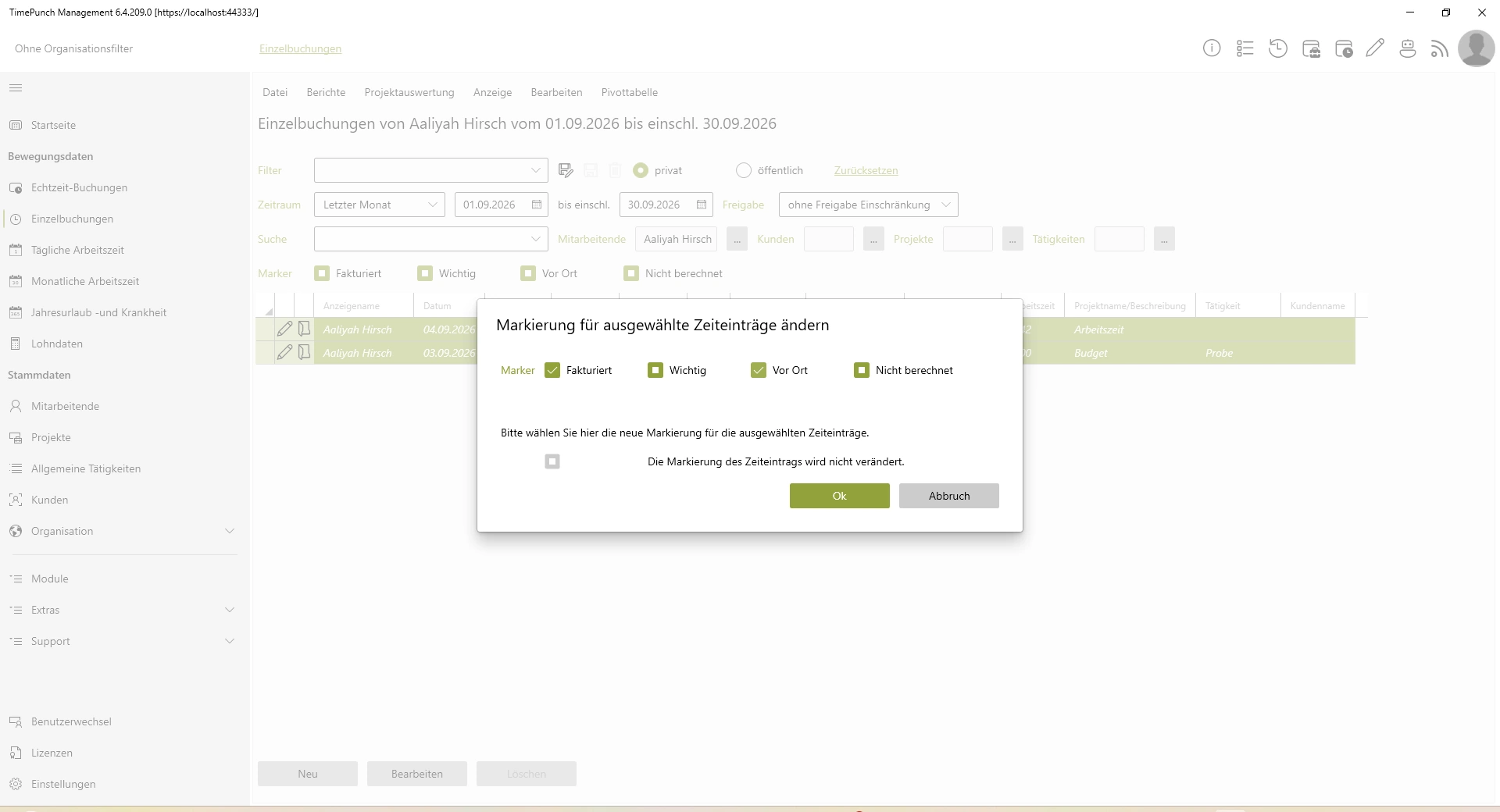
TimePunch now allows you to adjust markers even for closed months.
Access Rights for Activities
With TimePunch 6.4, rights management within projects becomes even more flexible.
In the future, project managers will not only be able to specify which employees are assigned to a project, but also which activities or tasks within the project the respective employees are allowed to log.
This allows for precise control over who is authorized to take on which tasks and log the corresponding times.
This provides greater clarity and more precise allocation of recorded project hours, especially for projects with varying responsibilities or clearly defined areas of work.
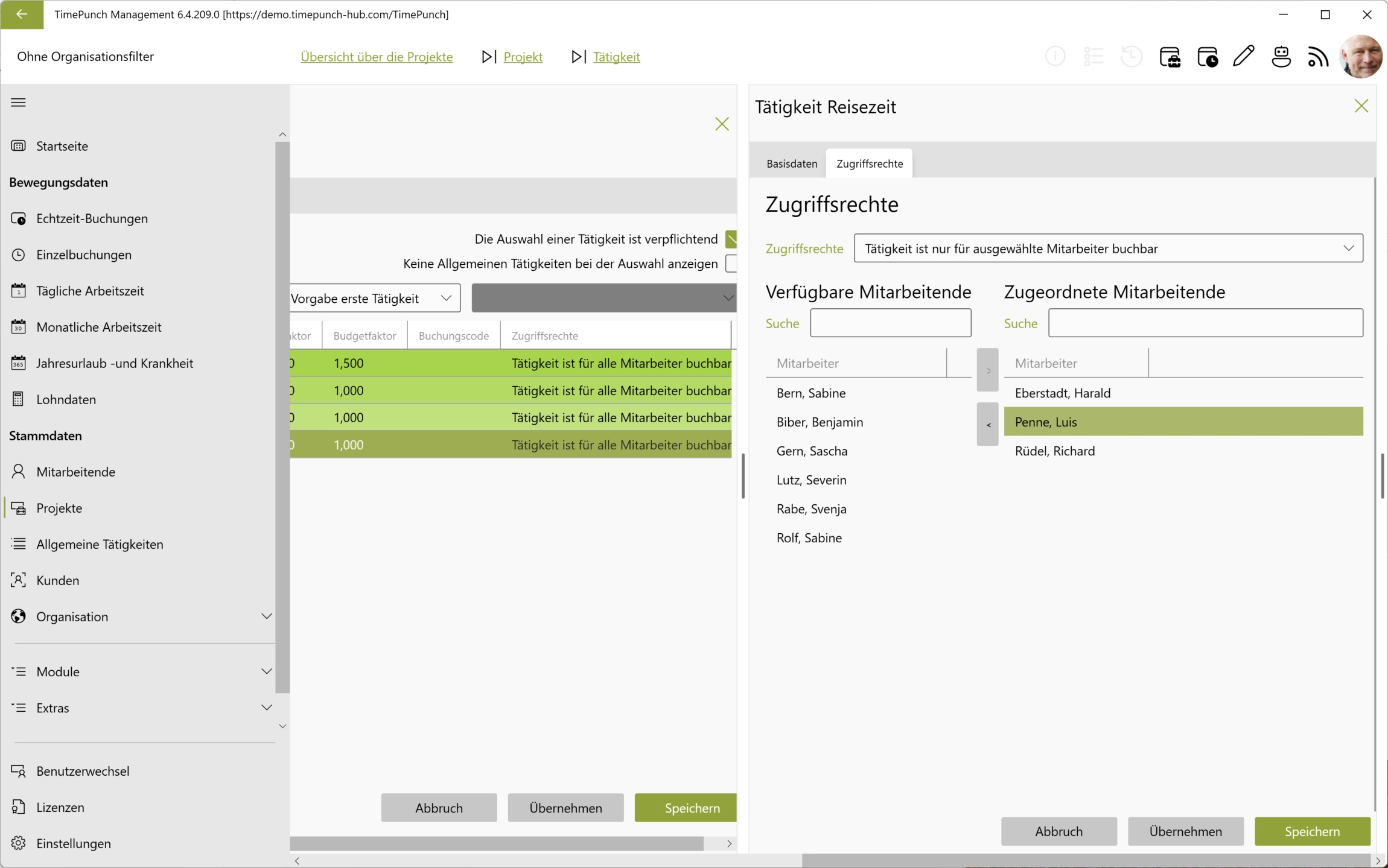
Access rights can now also be defined for individual tasks.
New Options for Production Data Collection
Our Datafox module has also been functionally expanded with TimePunch 6.4.
In addition to the standard tracking of work and project times, unit counts and other production-related data can now be recorded directly at the time-tracking terminal or via a barcode scanner.
This information can then be used in TimePunch for further analysis, such as for target-actual comparisons in production.
Alternatively, the recorded data can be transferred to a connected ERP system and used there, for example, for order billing.
Create New Projects Directly via Barcode
Another new feature is the ability to create new projects or orders directly by scanning a barcode using a project template.
Important settings can already be stored in this template, such as:
- Activities and tasks
- Hourly rates
- Access rights and permissions
- Other project-specific settings
When creating the new project, these settings are automatically applied.
This makes it possible to create recurring production orders in TimePunch significantly faster and with consistent settings.
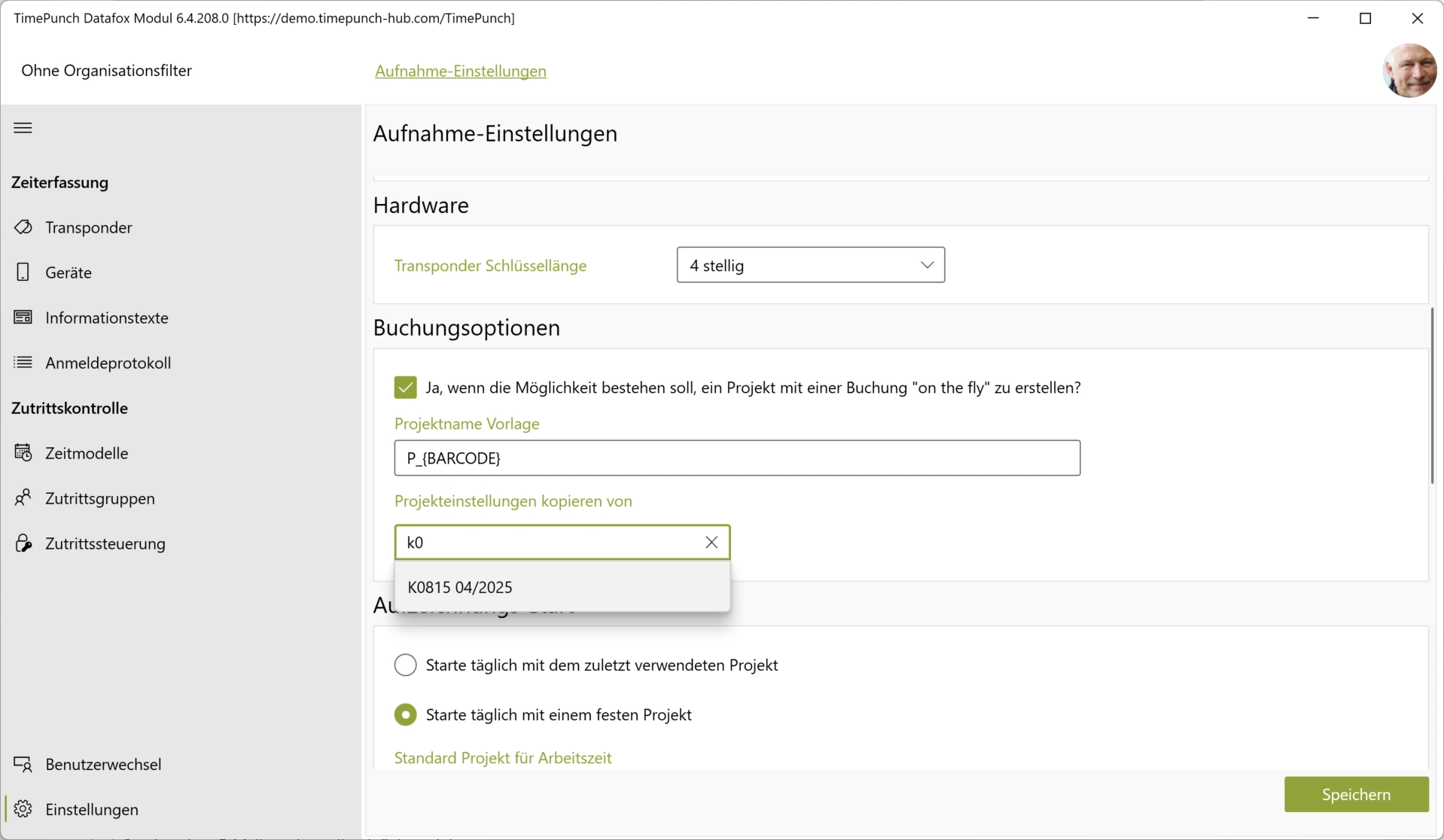
New orders can be created directly from a project template.
Remote Assignment in Project Allocation
The project allocator also receives a practical enhancement in TimePunch 6.4.
Previously, working hours could be retroactively assigned to various projects and activities via the project allocator.
In the future, it will also be possible to distinguish between on-site and remote working hours.
For example, tasks performed outside the office or at a client’s site can be directly marked with the appropriate designation.
This simplifies later analysis and enables a more precise distinction between different types of assignments within a project.
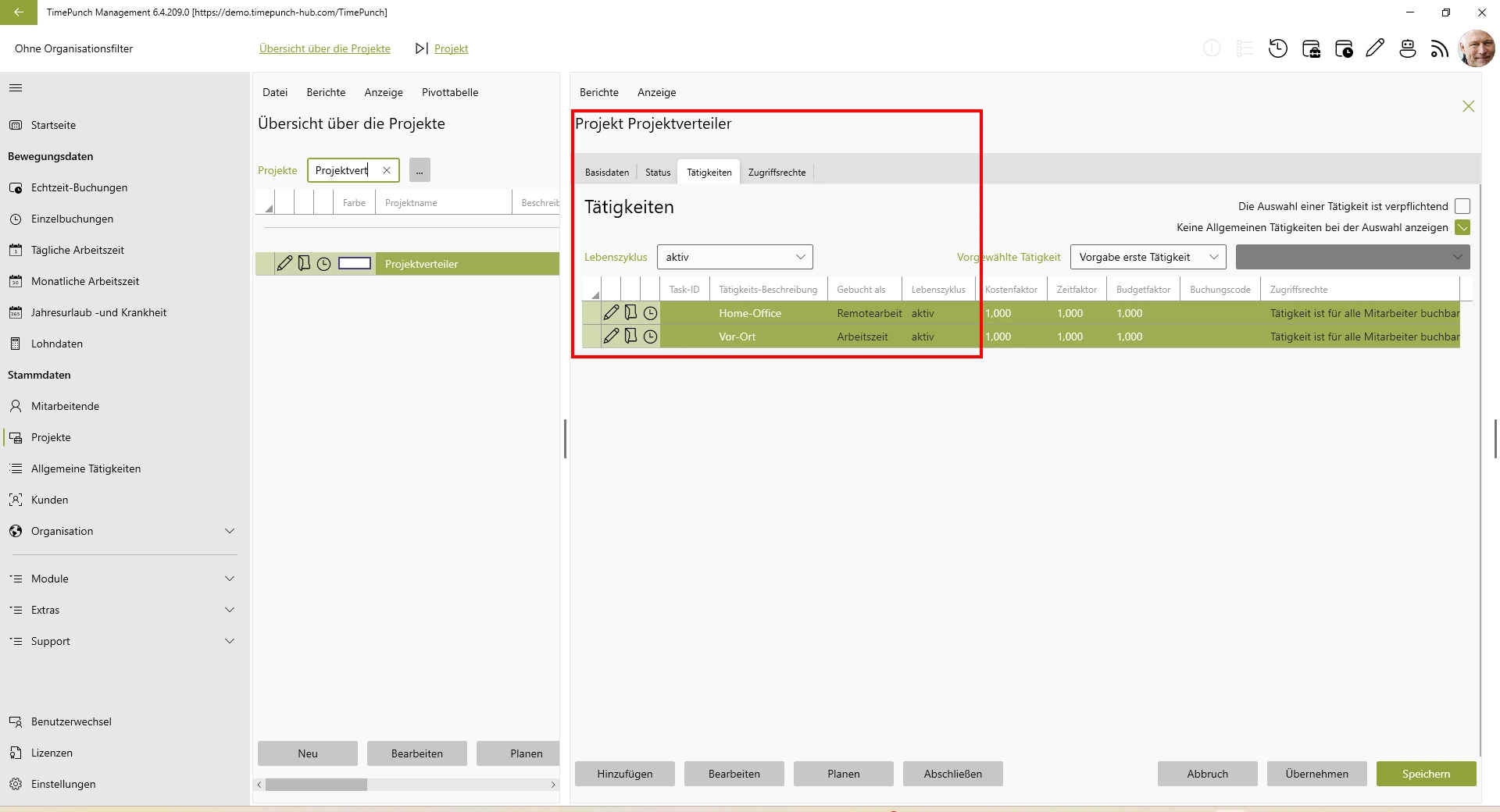
New activities in the project distribution list allow for the assignment of on-site and remote hours.
Server Online Connection for Locally Installed Terminals
A particularly interesting new feature awaits our customers who use TimePunch with locally installed Datafox time-tracking terminals.
With TimePunch 6.4, we are introducing support for the first time for server-online functionality for locally connected terminals.
Previously, the terminals were polled by the TimePunch server at regular intervals, typically once per minute.
With the new server-online connection, the devices remain permanently connected to the server via the network and can exchange information directly.
Reliable Switching Between Terminal and Online Time Tracking
A key advantage becomes apparent when combining different time-tracking options.
With the previous Smart Tag technology, the current attendance status was stored directly on the RFID transponder.
This worked reliably as long as employees recorded their clock-ins and clock-outs exclusively at the terminal.
However, if, for example, an employee checked in at the terminal in the morning and checked out via the online module in the evening, the status stored on the transponder could not be updated accordingly.
The result: The next time the employee logged in at the terminal, a “check-out” entry might have been triggered instead of a “check-in” entry.
With the new Server Online feature, this limitation is a thing of the past.
Before recording a time entry, the terminal queries the current attendance status directly from the TimePunch Server. This ensures that the next entry is correctly recorded as a clock-in or clock-out—regardless of whether the previous entry was made at the terminal or via the online module.
This significantly reduces the number of incorrect clock-ins. At the same time, combining different clock-in methods becomes much more convenient.
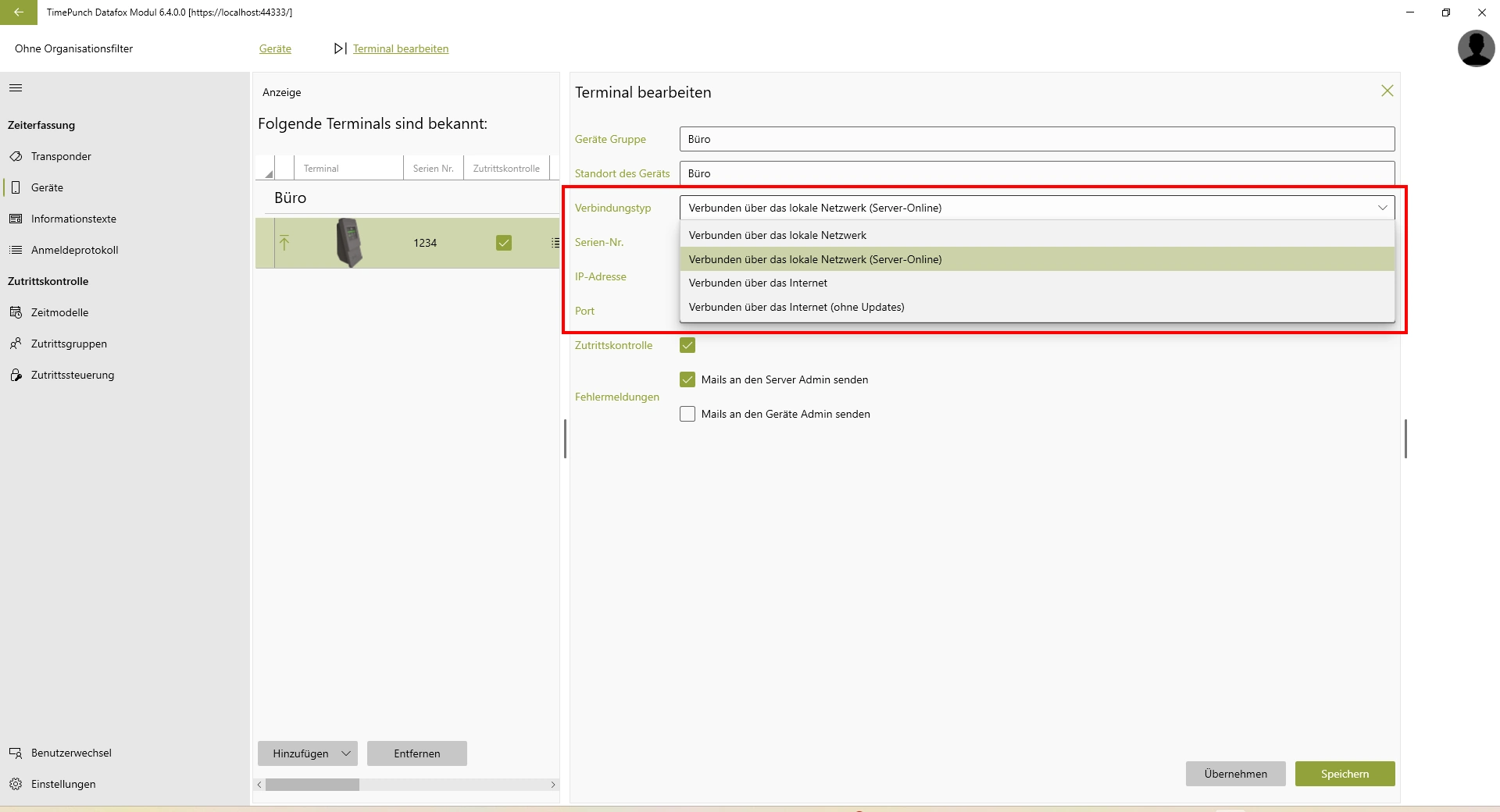
The Server Online functionality enables direct feedback from the TimePunch Server.
Would you like to migrate your existing terminals to the new Server Online feature?
If so, please feel free to contact our support team. We’ll assist you in testing your existing devices and migrating to the new connection.
The following improvements have been made
- FS#2332 – Option to toggle between duration and start/end times in the self-report
- FS#2309 – Daily entries in the self-report are now displayed the same way as in the online module
- FS#2304 – Text is displayed in italics for completed months in the online module and the self-report
- FS#2226 – Activity multipliers are now rounded to 3 decimal places
The following bugs have been fixed
- FS#2335 – The audit panel was not updated after re-logging in to Management
- FS#2330 – The data protection coordinator could not fully use the organization filter
- FS#2328 – Multipliers were not reset when activities were reset via the context menu
- FS#2324 – General activities with the barcode scanner did not function correctly
- FS#2321 – When switching between office and remote work, an incorrect attendance status was sometimes displayed
- FS#2320 – The status report was only accessible for one’s own entries
- FS#2319 – The automatic closing of time entries did not take existing times into account
- FS#2316 – DataFoxService, System.ArgumentNullException: The value must not be NULL.
- FS#2307 – Time entries that had already been trimmed were sometimes trimmed again later
- FS#2303 – Double-clicking on a completed day opened a change request
- FS#2299 – Empty transponder IDs were transferred to access groups